Category: Marketing Management

The Influence of Demographic Factors on Customer Decision-Making Process and Buying Behavior

The customer decision-making process, a complex interplay of internal and external factors, shapes the choices consumers make when purchasing products or accepting service offers (Principles of marketing, 2015). Among these influential factors, demographic elements such as age, gender, income, and education play pivotal roles in shaping customer behavior and influencing their decisions. This article examines why demographic factors hold significance in the customer’s decision-making process and how they impact buying behavior.

Age: Age is a dynamic determinant of consumer behavior. As individuals progress through different life stages, their needs, preferences, and priorities evolve. During youth, the inclination might be towards entertainment, fashion, and leisure activities, while as people mature, priorities shift towards more utilitarian and practical choices (Pratap, 2021). A marketer’s understanding of the target audience’s age group aids in tailoring products, advertisements, and marketing strategies to align with their evolving needs.

Gender: Gender significantly influences consumer behavior. Men and women have distinct cognitive, emotional, and social characteristics that impact their purchasing patterns. Men and women may differ in terms of sensitivity, decision-making processes, and factors that influence their buying choices (Lakshmi et al., 2017). By recognizing these gender-based nuances, marketers can design campaigns that resonate better with each gender’s unique traits and preferences.

Following figure (Figure 1) will give you a supportive though about how importance of Gender in buying behavior.

Figure 1

Difference between shopping styles of men and women
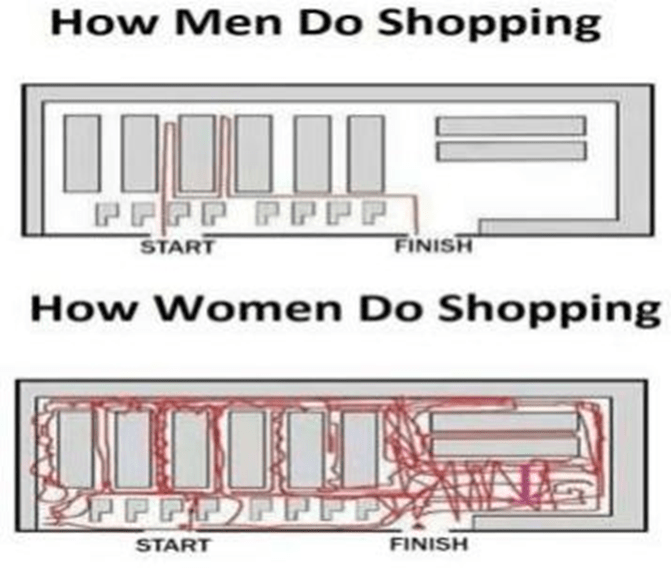
Note: By Lakshmi et al., 2017, the figure shows the difference between how men and women do shopping

Income: Income levels hold sway over the purchasing decisions of consumers. Individuals with lower incomes prioritize essential products that cater to their basic needs, while those with higher incomes may indulge in luxury or lifestyle items (Pratap, 2021). Marketers need to understand the financial capacities of their target audience to offer products that are not only aligned with their budget but also provide value.

Education: Education levels significantly impact consumer behavior. Highly educated consumers tend to be more discerning and thorough in their decision-making process. They are more likely to conduct extensive research, seek in-depth information, and make informed choices. In contrast, less educated individuals might be more susceptible to impulse buying or be influenced by advertisements (Principles of marketing, 2015). Tailoring marketing strategies to accommodate varying levels of consumer education can yield more effective results.

Conclusion: The interplay between demographic factors and consumer decision-making is intricate and impactful. Age, gender, income, and education contribute to shaping individuals’ preferences, needs, and buying behavior. Marketers must grasp these demographic nuances to create targeted and relevant marketing strategies. By understanding the diverse needs of different customer segments, businesses can tailor their offerings, advertisements, and approaches to build stronger customer connections and drive more effective results.

Word Count: 409

References:

Principles of marketing. (2015). Retrieved from University of Minnesota Libraries Publishing: https://doi.org/10.24926/8668.1901

Lakshmi, V. V., Niharika, D. A., Lahari, G. (2017). Impact of Gender on Consumer Purchasing Behaviour. IOSR Journal of Business and Management (IOSR-JBM).

Pratap, A. (2021, December 27). Effect of Demographic Factors on Consumer Behavior: Age, sex, Income and Education. Retrieved from https://notesmatic.com/effect-of-demographic-factors-on-consumer-behavior-age-sex-income-and-education/

Key Components of an Effective Strategic Marketing Plan

Introduction

Developing a strategic marketing plan is a multifaceted endeavor that involves meticulous analysis, forward-looking vision, and systematic execution. This paper delves into the core components that constitute a successful strategic marketing plan, drawing insights from the mission statements of Amazon and Wal-Mart to underscore the significance of these elements in driving business growth.

Analysis of Mission Statements

Amazon’s Mission Statement: Amazon’s mission statement reflects a forward-looking orientation that resonates with its position as a customer-centric global marketplace (Olsen, 2021). The statement’s emphasis on becoming the world’s most customer-centric marketplace showcases the company’s commitment to innovation and responsiveness to evolving customer needs. This futuristic perspective aligns with the principles of market orientation, as it seeks to anticipate and meet consumer demands and preferences (Kopp, 2021).

Wal-Mart’s Mission Statement: Wal-Mart’s mission centers on a value proposition that revolves around saving customers money to enhance their quality of life (About Walmart, n.d.). This promise is substantiated by the company’s extensive network of retail stores, clubs, and digital platforms that consistently offer competitive pricing. By delivering on this mission, Wal-Mart reinforces its dedication to customer value and convenience, establishing a strong foundation for its strategic planning.

Key Components of a Strategic Marketing Plan

  1. Mission and Vision Statements: Mission and vision statements provide a clear sense of purpose and direction for an organization. A well-defined mission statement encapsulates the company’s raison d’être, while a visionary statement sets the long-term goals and aspirations, ensuring alignment across the organization.
  2. Core Values: Core values establish the ethical framework and cultural norms that guide an organization’s behavior. These values underscore the company’s commitment to integrity, accountability, and social responsibility, shaping its interactions with stakeholders.
  3. Comprehensive Analysis: An effective strategic marketing plan requires a thorough analysis of both internal and external factors. This entails assessing the organization’s strengths and weaknesses, identifying market opportunities, understanding consumer behaviors, and evaluating competitive landscapes.
  4. Technology Integration: In the digital age, technology plays a pivotal role in marketing strategies. Integrating technology allows for data-driven decision-making, targeted communication, and enhanced customer engagement. Technological tools facilitate the collection and analysis of consumer insights, enabling the refinement of marketing efforts.
  5. Resource Allocation and Implementation: A well-crafted marketing plan allocates resources strategically to ensure optimal execution. This involves allocating financial resources, human capital, and materials to support marketing initiatives, campaigns, and projects.

Conclusion

A robust strategic marketing plan comprises key components that collectively shape an organization’s trajectory. Mission and vision statements provide a purposeful direction, while core values serve as guiding principles. Comprehensive analyses offer insights into market dynamics, technology integration facilitates innovation, and strategic resource allocation ensures efficient execution. By leveraging these components, companies can navigate the complexities of today’s competitive landscape, drive brand recognition, foster customer loyalty, and achieve sustainable growth.

Word Count: 454

References

Olsen, E. (2021, April 03). Mission Statements. Retrieved from OnStrategy: https://onstrategyhq.com/resources/mission-statements/

Kopp, C. M. (2021, February 27). Market Orientation. Retrieved from Investopedia: https://www.investopedia.com/terms/m/market-orientation.asp#:~:text=Market%20orientation%20is%20an%20approach,and%20services%20that%20satisfy%20them.&text=It%20may%20sound%20obvious%2C%20but,product%20development%20is%20the%20opposite.

About Walmart. (n.d.). Retrieved from Walmart: https://corporate.walmart.com/about

Success of Shwe Pyi Nann’s Cosmetic brand and its products

A product can be a good or service or the combination of these two that is available in the market for sale to the end consumer while a brand is a combination of promise, wants and emotions and is associated with reliability, credibility, and quality that gives a sense of satisfaction to the customers (Surbhi, 2018).  This research paper is an analysis of a successful brand and products of a cosmetic company, named “Shwe Pyi Nann”, which is the biggest, most successful, and longest standing cosmetics brand in Myanmar formerly known as Burma. The brand, Shwe Pyi Nann, means “Golden Kingdom’s Palace”.

Brand Background

Shwe Pyi Nann Group was established in 1940 and mainly produces Thanakha (known as Burmese traditional Makeup) which is Myanmar Traditional Cosmetic Obtained from Limonia Acidissima tree with the brand name of “Shwe Pyi Nann”. Traditionally, Burmese people grind the tree bark against a flat and wet circular smooth stone then put the paste on the face as a unique traditional makeup for daily life that can only see in Myanmar (Thanakhar, 2020).

After Shwe Pyi Nann group found that Thanakha contains natural cormorant and can prevent Ultra Violet rays when it was tested and analyzed in the laboratory, they tried to produce as a natural cosmetic product and to implement international quality management standards and got ISO certification (Shwe Pyi Nann Thanakha Products, n.d.). Nowadays, the product has been mixed up with essential floral and herbal oil and water. The user no longer need to grind the bark and can readily put the paste by mixing a required amount of water to be able to apply on the face.

Analysis of marketing media

            Shwe Pyi Nann was found that they firstly advertised their products through state owned media like TV channels and radios since their production. For today, The Company mostly uses Facebook as a marketing medium. By posting descriptions for each product, questionnaires for the reviews, knowledge for the products, and promotion posters, the page would be getting a lot of organic reach. In addition, the Company conducts promotion shows through hiring traditional comedy artists in most of the big cities throughout the country. Furthermore, they expend their customers through Facebook and YouTube when the records of comedy shows uploaded on. For exporting and local distributions of their products, they use their owned website.

Analysis of 4 Ps of marketing

Marketing includes four activities (creating, communicating, delivering, and exchanging offerings) which are traditionally viewed as 4 Ps of marketing: product, promotion, place, and price although there are different characteristics (Principles of marketing, 2015). 4 Ps of Shwe Pyi Nann can be analyzed in the following statements.

Product – All of the products are made with Thanakha by mixing flower stamen of ironwood tree, lime, jasmine, milk and Aloe Vera. Different kinds of products with different sizes can be found in the following kinds of cosmetics:

  • Natural Thanakha paste which is ready to apply,
  • Facial form,
  • Pudding Face Cream,
  • Body lotion, and
  • Moisturizers.

Promotion – Facebook is main advertising and promotion tool although TV channels were their first promotion communication. For reaching out to a lot of new customers, they conduct promotion shows with the most popular comedy artists.

Place – Shwe Pyi Nann mainly distributes their products in local cosmetic shops across the country where every consumer can be easily accessible to their products. E-commerce website cannot be found and they just use Facebook platform for online selling. Most of the products can also be found in supermarkets in big cities. 

Price- Most price around 2 USD for all of the products are not too high and can be affordable for any age, gender, and race. The customer can feel it is worth to use their products with these prices and descriptions of the products can give the reliability to apply.

Value proposition

As a value proposition which is the promise of value that our customer can expect our business can provide services or products which a competitor can’t offer (Coleman, 2022). I have formulated a value proposition for the brand of Shwe Pyi Nann as following.

“Established in 1940, Shwe Pyi Nann is the best local brand in Myanmar, producing high-quality Myanmar’s Thanakha skin care products which have no chemical that might harm your skin and has been mixed up with essential floral, herbal oil, and water.”

In conclusion, Shwe Pyi Nann strongly stands today as the biggest, most successful, and longest standing cosmetics brand with incomparable experience, expertise and distributions networks accumulated over 75 years in Myanmar’s cosmetics industry.

References

Coleman, B. (2022, January 21). How to Write a Great Value Proposition. Retrieved from Hubspot: https://blog.hubspot.com/marketing/write-value-proposition

Principles of marketing. (2015). Retrieved from University of Minnesota Libraries Publishing

Shwe Pyi Nann Thanakha Products. (n.d.). Retrieved from Shwe Pyi Nann: http://www.shwepyinann.com/companies/shwe-pyi-nann/products/shwe-pyi-nann-thanakha-products

Surbhi, S. (2018, July 26). Difference Between Product and Brand. Retrieved from Key Differences: https://keydifferences.com/difference-between-product-and-brand.html#:~:text=The%20product%20is%20an%20item,is%20something%20more%20than%20that.

Thanakhar (Burmese Traditional Make-up). (2020, August 21). Retrieved from Lucky Treasure Travels & Tours: https://www.luckytreasuretravels.com/blog/post/thanakhar-burmese-traditional-make-up/

Expanding Reach to End-Users for Ah May Htwar Peanut Oil: A Strategic Approach

Introduction

Imagine inheriting Ah May Htwar (AMH), a reputable local peanut oil producer in Myanmar. Established in 2002, AMH’s success has been driven by its commitment to quality, utilizing traditional techniques fused with modern advancements. This paper outlines a strategy to extend AMH’s distribution to end-users, tapping into new market segments and fortifying its market presence.

Background and Product Overview

AMH specializes in producing premium peanut and sesame oil, offering various bottle sizes catering to diverse consumer needs. Our products are manufactured using cutting-edge technology, clean raw materials, and meticulous production processes. Quality assurance is maintained through Total Quality Management (TQM) practices. With FDA and ISO certifications, AMH guarantees consumer safety and satisfaction (Ahmay Htwar Profile, n.d.).

Current Distribution Landscape and Ambition

Traditionally, AMH has fostered relationships with over 3,500 distributors, spanning local eateries, supermarkets, and small shops nationwide. However, to elevate our market reach, we envision extending our distribution network to end-users, forging direct connections with consumers across the country.

Target Market

Our expansion focuses on three key consumer groups:

  1. Health Enthusiasts: Individuals seeking fresh, pure, and unadulterated peanut oil.
  2. Housewives: Those desiring untainted peanut oil for their culinary needs.
  3. Respectful Individuals: Individuals valuing the tradition of gifting pure peanut oil to elders, complemented by innovative packaging.

Approach and Value Proposition

To capture our target market’s attention, we will leverage social media platforms like Facebook, tapping into their extensive reach and engagement capabilities. Our unique value proposition, “AMH’s benevolence to customer,” resonates with our commitment to quality and customer well-being.

Value Proposition Components

“The essence of healthy and happy family longevity is the taste of life.”

  1. Advanced Technology: Our products are crafted using advanced techniques, ensuring quality and purity.
  2. Uncompromised Quality: We provide fresh peanut oil devoid of any additives, maintaining the genuine flavor.
  3. Premium Ingredients: Only the finest clean raw peanuts and sesame are used, contributing to the exceptional taste.
  4. TQM Production: Our products are manufactured under Total Quality Management practices, guaranteeing consistent excellence.
  5. Certified and Approved: With FDA and ISO certifications, AMH products are backed by official validation.

Understanding Competitors

AMH faces competition from local counterparts like Yangon Pure Peanut Oil Company and Bayin Peanut Oil Company. These competitors primarily target local supermarkets, restaurants, and international e-commerce platforms, such as Amazon (Wanjiru, 2019).

Conclusion

Expanding distribution to end-users presents an opportunity for AMH to cultivate deeper connections with consumers and carve a unique niche in the market. By emphasizing our value proposition and capitalizing on social media, AMH is poised to create a lasting impact and further solidify its position as a provider of premium peanut and sesame oil products.

References

Ahmay Htwar Profile. (n.d.). Retrieved from Ahmayhtwar: http://www.ahmayhtwar.com/index.mm.html

Wanjiru, S. (2019, Mar 19). Target Marketing and Competition. Retrieved from Medium: https://medium.com/@shiphillahwanjiru/target-marketing-and-competition-6deb1ca4e65f

Coleman, B. (2022, January 21 ). How to Write a Great Value Proposition. Retrieved from Hubspot: https://blog.hubspot.com/marketing/write-value-proposition

Principles of marketing. (2015). University of Minnesota Libraries Publishing. https://doi.org/10.24926/8668.1901 (Original work published 2010)